Green beans, soybeans, adzuki beans and other types of legumes and miscellaneous grains are important raw materials for food processing, grain and oil storage, and dietary ingredients. Drying and dehydration are key pre processes for miscellaneous grain storage, long-distance transportation, and deep processing. The traditional drying method has problems such as long drying time, uneven heating, and external dryness and internal humidity, making it difficult to adapt to the large-scale and high-quality processing needs of miscellaneous grains. The implementation of low-temperature drying technology in microwave tunnel ovens effectively solves the pain points of traditional processes, achieving the processing effect of dehydration, freshness locking, and long-term storage resistance of miscellaneous grains. It is currently the preferred technology for industrial pretreatment of legumes and miscellaneous grains.

The microwave tunnel oven is different from the traditional heat conduction heating mode from the surface to the inside. Relying on the unique body heating technology of microwave, it can penetrate the interior of bean particles, activate the high-speed oscillation friction heat generation of water molecules in miscellaneous grains, and achieve synchronous and uniform heating and dehydration inside and outside. The entire processing process can be quickly completed within a few minutes without the need for high-temperature baking. It can flexibly control the drying rhythm and quickly strip the free water inside the beans in a short period of time, stabilizing the moisture content below the critical value for mold growth. This fundamentally eliminates problems such as moisture, mold, deterioration, and insect infestation during the storage and transportation of miscellaneous grains, greatly extending the shelf life of legumes and miscellaneous grains.

In terms of quality retention, the core advantage of low-temperature short-term drying is particularly prominent. The whole process is fast and the temperature is low, which can effectively preserve the original nutrients of miscellaneous grains without damaging the original particle shape, natural color, and original bean aroma of the beans. The processed mung beans, soybeans, and adzuki beans have plump and uniform particles, without any drying, cracking, or burning phenomenon, with a pure taste that meets the quality standards for deep processing of food and the sale of miscellaneous grains.
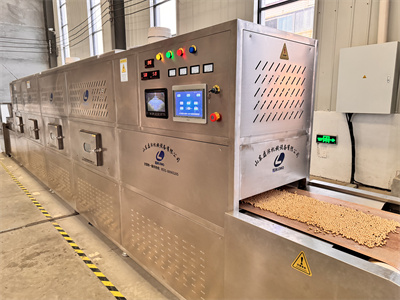
The equipment adopts a fully automatic tunnel type assembly line operation, and materials are continuously transported in and out of the equipment at a constant speed. The processing speed, temperature, and power can be flexibly adjusted, suitable for large-scale and standardized industrial production. The processing efficiency far exceeds traditional processes, greatly reducing labor and time costs, and adapting to the mass production needs of various grain processing enterprises.




 QQ
QQ